by Andrew Griffith, Livestock Marketing Specialist
September 11, 2026
Overview
Corn, Soybean, and Wheat down; Cotton up for the week
Fuel
Fuel prices continue to surge as the geopolitical situation has continued to slow oil movement and tensions are high in a global market. The increase in gas price is beginning to eat into consumer disposable income, which means they do not have the same buying power for other goods. The alternative is to drive less and thus reduce fuel usage, but that would seem to take away a person’s independence! The diesel price is more of a concern from the farming world as harvest is ongoing in many areas and soon to start in others. The year-over-year increase in diesel price is $1.34 per gallon, which does not change per acre cost much, but it does eat into profits.
| Fuel | Regular | Mid-Grade | Premium | Diesel |
|---|---|---|---|---|
| Current Avg. | $3.92 | $4.40 | $4.80 | $5.76 |
| Yesterday Avg. | $3.89 | $4.38 | $4.79 | $5.70 |
| Week Ago Avg. | $3.83 | $4.31 | $4.71 | $5.59 |
| Month Ago Avg. | $3.57 | $4.04 | $4.45 | $4.99 |
| Year Ago Avg. | $2.81 | $3.27 | $3.67 | $3.42 |
| Indicator | Previous | Current | Change |
|---|---|---|---|
| USD Index | 99.19 | 99.04 | -0.12 |
| Crude Oil | 91.43 | 100.41 | 8.98 |
| DJIA | 53381 | 52595 | -785 |
Corn
Across Tennessee, average corn basis (cash price-nearby futures price) declined 12 cents from last week at West, Northwest, West-Central, North-Central, and Mississippi River elevators and barge points. Overall, basis for the week ranged from 23 cents under to 5 cents under, with an average of 16 cents under the September futures at elevators and barge points. Ethanol production for the week ending September 4th was 1.099 million barrels, down 11,000 barrels compared to the previous week. Ethanol stocks were 25.187 million barrels, up 152,000 barrels compared to the previous week. Cash prices ranged from $4.85 to $5.16 at elevators and barge points.On Friday, September 2026 corn futures closed at $5.10, which is down 2 cents compared to last week. For the week, September 2026 corn futures traded between $5.05 and $5.21.
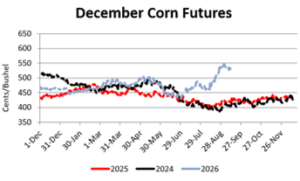
Nationally, the Crop Progress report estimated corn condition at 56% good-to-excellent (down 1% from last week) and 17% poor-to-very poor (no change from last week); corn mature to be 25% compared to 13% last week, 24% last year, and a 5-year average of 23%. In Tennessee, corn condition was estimated at 79% good-to-excellent (down 1% from last week) and 5% poor-to-very poor (up 1% from last week); corn mature to be 81% compared to 68% last week, 82% last year, and a 5-year average of 55%. This week new crop cash contracts ranged from $4.91 to $5.34 at elevators and barge points.For the week of August 28- September 3, 2026, net sales of 1,928,700 MT for the 2026/2027 marketing year, were primarily for Mexico (861,100 MT), Japan (294,300 MT), Colombia (174,100 MT), South Korea (96,900 MT), and Taiwan (92,700 MT). Exports for the period ending August 31, of 953,600 MT brought accumulated exports to 86,014,300 MT, up 25 percent from the prior year’s total of 69,081,400 MT. December corn futures closed at $5.30, down 8 cents from last week.
Soybeans
Across Tennessee average soybean basis decreased 1 cent compared to last week at West, Northwest, North-Central, West-Central, and Mississippi River elevators and barge points. Average basis ranged from 25 under to 5 cents over the September futures contract, with an average basis of 11 cents under at the end of the week. Cash soybean prices at elevators and barge points ranged from $12.70 to $13.39. September 2026 soybean futures closed at $12.80, down 14 cents compared to last week. For the week, September 2026 soybean futures traded between $12.80 and $13.18.
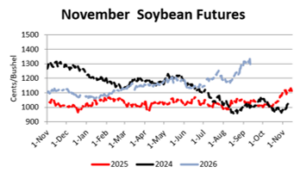
Nationally, the Crop Progress report estimated soybean condition at 58% good-to-excellent (no change from last week) and 13% poor-to-very poor (no change from last week); soybean dropping leaves to be 26% compared to 13% last week, 20% last year, and a 5-year average of 20%. In Tennessee, soybean condition was estimated at 74% good-to-excellent (down 1% from last week) compared to 6% poor-to-very poor (up 1% from last week); dropping leaves to be 59% compared to 45% last week, 39% last year, and a 5-year average of 28%. For the week of August 28- September 3, 2026, net sales of 2,637,300 MT for 2026/2027 marketing year, were primarily for China (1,222,000 MT), Indonesia (222,200 MT), Mexico (169,300 MT), and Taiwan (122,700 MT). Exports for the period ending August 31 of 251,000 MT brought accumulated exports to 41,006,500 MT, down 18 percent from the prior year’s total of 50,105,900 MT. November 2026 soybean futures closed at $12.97, down 13 cents compared to last week.
Cotton
North Delta upland cotton spot price quotes for September 10th were down compared to last week. Prices were 80.89 cents/lb (41-4-34), and 85.64 cents/lb (31-3-35), which made both up 1.28 cents compared to last week’s prices.
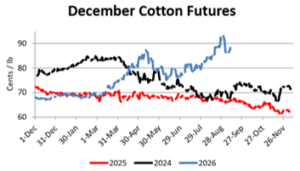
Nationally, the Crop Progress report estimated cotton condition at 34% good-to-excellent (down 5% from last week) and 32% poor-to-very poor (no change from last week); cotton bolls opening to be 40% compared to 29% last week, 38% last year, and a 5-year average of 38%. In Tennessee, the Crop Progress report estimated cotton condition at 70% good-to-excellent (down 2% from last week) and 10% poor-to-very poor (up 1% from last week); cotton bolls opening to be 52% compared to 41% last week, 41% last year, and a 5-year average of 30%. For the week August 28-September 3, 2026, net sales of Upland totaling 73,900 RB for 2026/2027 were primarily for Pakistan (19,400 RB), Vietnam (17,500 RB), Mexico (11,900 RB), Bangladesh (10,500 RB), and India (9,500 RB). Exports of 177,800 RB were primarily to Vietnam (50,300 RB), India (47,000 RB), Pakistan (17,600 RB), Honduras (11,800 RB), and Mexico (11,000 RB). On Thursday, December 2026 cotton futures closed at 88.22 cents, up 1.77 cents compared to last week. December 2027 cotton futures closed at 80.17 cents, up 0.63 cents compared to last week.
Wheat
Wheat cash prices at elevators and barge points ranged from $6.41 to $6.60. July 2027 wheat closed at $7.46, down 7 cents compared to last week.
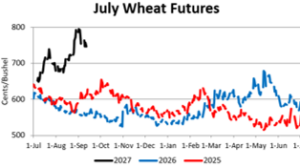
Nationally, the Crop Progress report estimated spring wheat harvested to be 86% compared to 77% last week, 83% last year, and a 5-year average of 83%. For the week of August 28-September 3, net sales of 194,200 metric tons (MT) for 2026/2027–a marketing-year low–were down 38 percent from the previous week and 43 percent from the prior 4-week average. Increases primarily for the Philippines (88,400 MT), Ecuador (30,000 MT), Mexico (28,500 MT), Japan (22,200 MT), and Honduras (19,000 MT). Exports of 493,600 MT were up 4 percent from the previous week and 3 percent from the prior 4-week average.
Additional Information
Links for data presented:
U.S. Export Sales – https://apps.fas.usda.gov/export-sales/esrd1.html
USDA FAS: Weekly Export Performance Indicator – https://apps.fas.usda.gov/esrquery/esrpi.aspx
EIA: Weekly ethanol Plant Production – https://www.eia.gov/dnav/pet/pet_pnp_wprode_s1_w.htm
EIA: Weekly Supply Estimates – https://www.eia.gov/dnav/pet/pet_sum_sndw_a_EPOOXE_sae_mbbl_w.htm
Upland Cotton Reports – https://www.fsa.usda.gov/FSA/epasReports?area=home&subject=ecpa&topic=fta-uc
Tennessee Crop Progress – https://www.nass.usda.gov/Statistics_by_State/Tennessee/Publications/Crop_Progress_&_Condition/
U.S. Crop Progress – http://usda.mannlib.cornell.edu/MannUsda/viewDocumentInfo.do?documentID=1048
USDA AMS: Market News – https://www.ams.usda.gov/market-news/search-market-news
If you would like further information or clarification on topics discussed in the crop comments section or would like to be added to our free email list please contact me at agriff14@utk.edu.